



Most boards and talent leaders know the CIO role has evolved. The disconnect shows up elsewhere—job descriptions, evaluation criteria, operating models, and hiring mandates that still reflect a version of the role designed for a very different moment.
In 2026, that lag matters.
Across CIO searches we’re leading for public companies, PE-backed platforms, and complex global organizations, one pattern is consistent: companies aren’t failing to hire “good” CIOs—they’re misdefining what the role is actually responsible for now.
This shift is explored in more detail in The Modern CIO: Leading Transformation in an Age of Intelligence, a guide based on hundreds of CIO searches across public companies, PE-backed firms, and high-growth technology organizations.
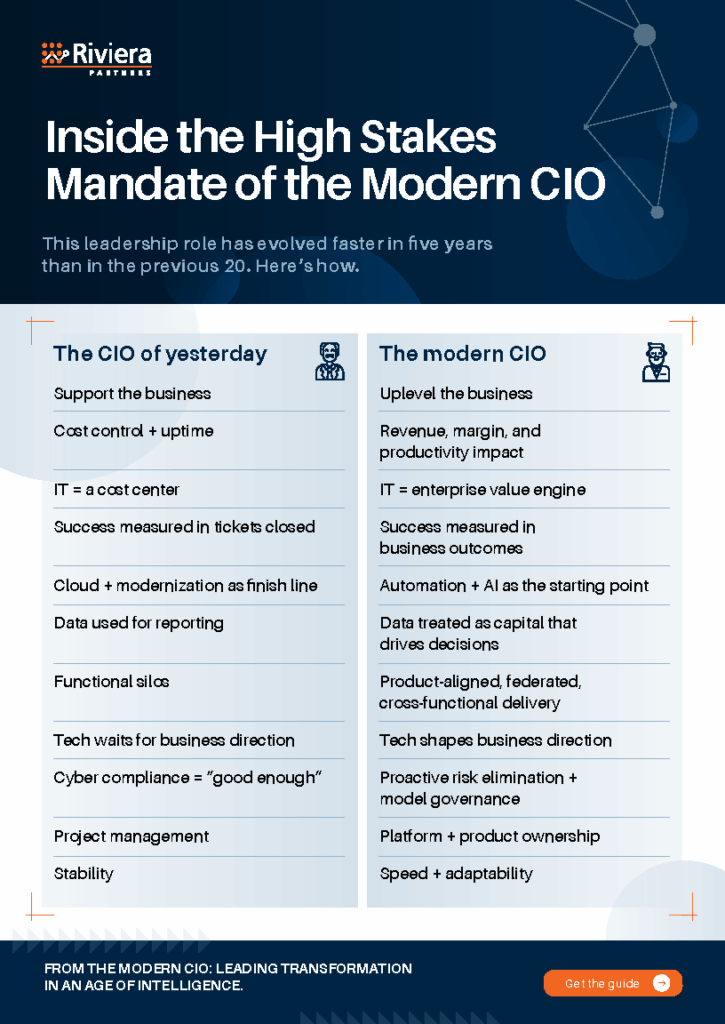
The modern CIO mandate: recentered and reinvigorated
Historically, the CIO’s success was anchored to stability:
- System uptime
- Vendor management
- Risk containment
- Cost control
Those expectations haven’t disappeared—but they’ve become table stakes.
What boards now scrutinize sits elsewhere:
- How intelligence flows through the business
- Whether technology investment translates into margin, speed, or leverage
- How data, automation, and platforms shape decision-making
- Whether operating models can scale without friction
In practice, the CIO has moved from supporting execution to designing how execution works.
A subtle shift on paper. But decisive in reality.
Why “outdated” isn’t the real issue
Your current CIO job description isn’t necessarily wrong. It’s more likely than not incomplete.
The tendency is to over-index on:
- Centralized IT ownership
- Functional control models
- Project delivery language
- Technical stewardship
And underweight:
- Enterprise intelligence design
- Operating-model influence
- Cross-functional authority
- Outcome-based accountability
The result? CIOs are often hired—or evaluated—as technology leaders while being expected to operate as business operators.
That gap shows up later as:
- Fragmented AI and automation efforts
- Unclear ownership of data and platforms
- Slower integration post-acquisition
- Persistent debates instead of decisions
What the modern CIO is actually accountable for
Based on hundreds of placements and ongoing CIO searches, expectations have converged around a clearer reality.
In 2026, modern CIOs are increasingly accountable for:
- Enterprise intelligence
- Designing how data, platforms, and automation work together—not as tools, but as operating infrastructure.
- Business outcomes
- Translating technology investment into measurable impact across margin, productivity, and scalability.
- Organizational design
- Shaping federated, product-aligned, data-embedded teams that can move without coordination drag.
- Governance at speed
- Establishing clarity around data ownership, AI usage, risk, and cost—without slowing execution.
- Executive influence
- Operating credibly at the board and C-suite level, not as a service provider, but as a peer.
This evolution—and the tradeoffs it creates—is explored in depth in The Modern CIO: Leading Transformation in an Age of Intelligence.
Why this matters even if you’re not hiring
A common refrain from boards and CHROs: “We’re not replacing our CIO.”
That’s often beside the point.
The more relevant question is whether:
- The role has been redefined clearly
- Authority matches accountability
- Success metrics reflect current reality
- The operating model enables what the strategy demands
In many cases, progress comes from recalibration.
But recalibration requires a shared understanding of what the role now exists to do.
A practical lens for talent leaders and boards
f you’re pressure-testing your CIO role in 2026, the signal isn’t tenure or technical depth alone.
It’s whether the role is positioned to:
- Own intelligence end-to-end
- Shape how work actually happens
- Translate complexity into clarity
- Scale decision-making—not just systems
That’s the difference between a CIO who maintains the business and one who materially shapes its trajectory.
More of what makes the modern CIO
These companion perspectives break the shift down further:
How organizations are thinking about different CIO archetypes depending on stage and strategy
Where ownership between CIO, CTO, and CDO is converging
The core capabilities that consistently differentiate high-impact CIOs in 2026
About Riviera Partners
Riviera Partners is a global executive search firm specializing in technology, product, and design leadership. With decades of experience and hundreds of successful CIO placements, Riviera helps boards and executives identify leaders who can drive transformation, intelligence, and enterprise value.