



Compensation has become one of the most common friction points in AI leadership hiring.
Across hundreds of executive searches over the past two years, one pattern appears repeatedly. Companies underestimate how much experienced AI leaders earn. Offers fall short. Candidates disengage. Searches slow down.
The gap is not driven by inflated expectations. It reflects how much these roles have expanded.
AI leaders in 2026 are being asked to oversee strategy, infrastructure, governance, adoption, and commercial outcomes. As responsibilities have grown, so has compensation.
The data below reflects what Riviera Partners sees across venture-backed, private equity-backed, and public technology companies.
Why AI Leaders Are Paid Differently
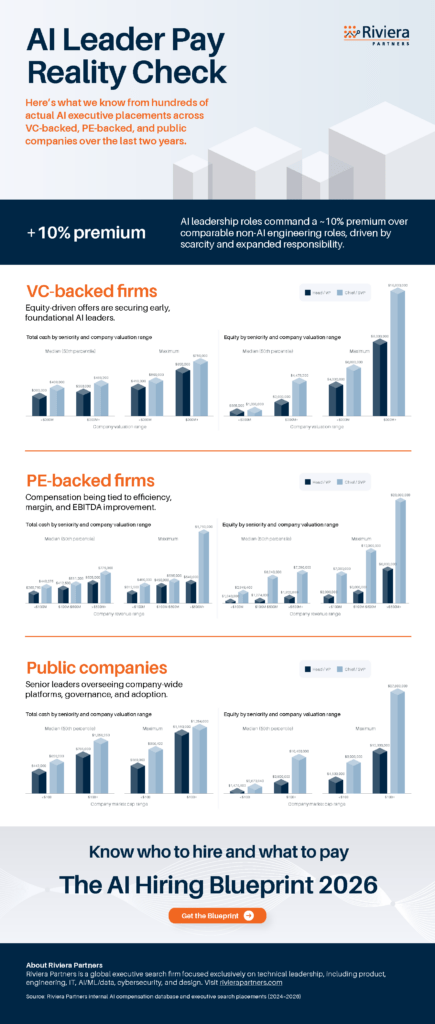
Across ownership models, senior AI executives now earn about 10 percent more than comparable non-AI engineering leaders.
This premium is not tied to hype. It reflects scarcity and scope.
Most experienced AI leaders today are expected to:
- Translate research into products
- Align AI programs with revenue goals
- Build cross-functional teams
- Manage regulatory and risk issues
- Report to boards and investors
Few executives have developed this mix of skills. Those who have are in sustained demand.
As a result, compensation has adjusted.
AI Compensation by Company Type
The structure of AI pay varies significantly depending on ownership model, growth stage, and business priorities.
The infographic below summarizes how compensation typically works across three major categories.
How Venture-Backed Firms Compensate AI Leaders
Venture-backed companies are usually hiring foundational AI leaders. These executives are expected to help define products, build teams, and shape long-term strategy.
Cash compensation is often moderate. Equity carries most of the upside.
In recent searches, Riviera Partners has seen equity packages commonly range from $4 million to $15 million for senior AI leaders at growth-stage companies.
These offers reflect the risk and opportunity associated with building an AI-native business from the ground up.
Candidates evaluating these roles focus heavily on product-market fit, leadership alignment, and capital stability.
How Private Equity-Backed Firms Structure Pay
Private equity-backed companies approach AI compensation differently.
Here, leadership roles are closely tied to value creation.
Pay packages are often linked to:
- Efficiency gains
- Margin expansion
- Cost reduction
- EBITDA improvement
When these targets are met, total compensation can exceed $20 million.
These roles appeal to operators who are comfortable working within performance-driven environments and managing complex transformation programs.
How Public Companies Pay AI Executives
At large public enterprises, AI leaders are responsible for company-wide platforms, governance frameworks, and adoption strategies.
These roles emphasize stability, compliance, and scale.
It is now common for senior AI leaders at major public companies to earn more than $1 million in annual cash compensation, with long-term equity awards approaching $30 million in total value.
These positions typically involve close collaboration with legal, risk, finance, and investor relations teams.
Why Many Offers Still Miss the Market
Despite growing transparency, many companies still struggle to benchmark AI compensation accurately.
Common issues include:
- Comparing AI leaders to traditional IT roles
- Underestimating governance responsibilities
- Ignoring equity expectations
- Overlooking regional market differences
When offers do not reflect market realities, strong candidates often disengage early in the process.
This leads to extended searches and lost momentum.
Compensation Is Only Part of the Equation
While pay matters, experienced AI leaders evaluate roles holistically.
In interviews, candidates consistently raise questions about:
- Reporting structure
- Budget authority
- Data quality
- Decision-making processes
- Board involvement
Competitive compensation cannot offset unclear authority or weak organizational support.
High-readiness companies tend to align compensation, structure, and expectations from the outset.
What This Means for 2026 Hiring Plans
Companies planning major AI hires in 2026 should approach compensation as part of a broader readiness assessment.
Before launching a search, leaders should be able to answer:
- How will this role drive business outcomes
- What authority will the leader have
- How will success be measured
- How does compensation reflect scope
Clear answers to these questions improve both candidate interest and long-term retention.
Clear answers to these questions improve both candidate interest and long-term retention.
Access the Full AI Hiring Data
This infographic reflects only a portion of Riviera Partners’ AI compensation research.
The full AI Hiring Blueprint 2026 includes:
- Detailed compensation benchmarks
- Market-by-market analysis
- Organizational readiness models
- Search best practices
- Talent supply insights
For boards, executives, and HR leaders preparing for AI hiring in 2026, the report serves as a practical reference.
👉 Explore The 2026 AI Hiring Blueprint to see the complete data.
About Riviera Partners
Riviera Partners is a global executive search firm focused exclusively on technical leadership, including product, engineering, IT, AI/ML/Data, cybersecurity, and design.