



As companies expand their use of artificial intelligence, most are discovering that technology alone does not determine results.
Research in The AI Hiring Blueprint 2026 suggests that only about 2 percent of organizations are structurally prepared to scale AI across the enterprise. The majority have invested in tools and pilots, but have not yet built the leadership, governance, and operating models needed to support sustained execution.
Across hundreds of executive searches, Riviera Partners continues to see the same pattern. Organizations make meaningful progress only after they align structure, authority, and incentives around AI. A smaller group of high-readiness companies has done this work early, shaping how effectively AI becomes part of daily operations.
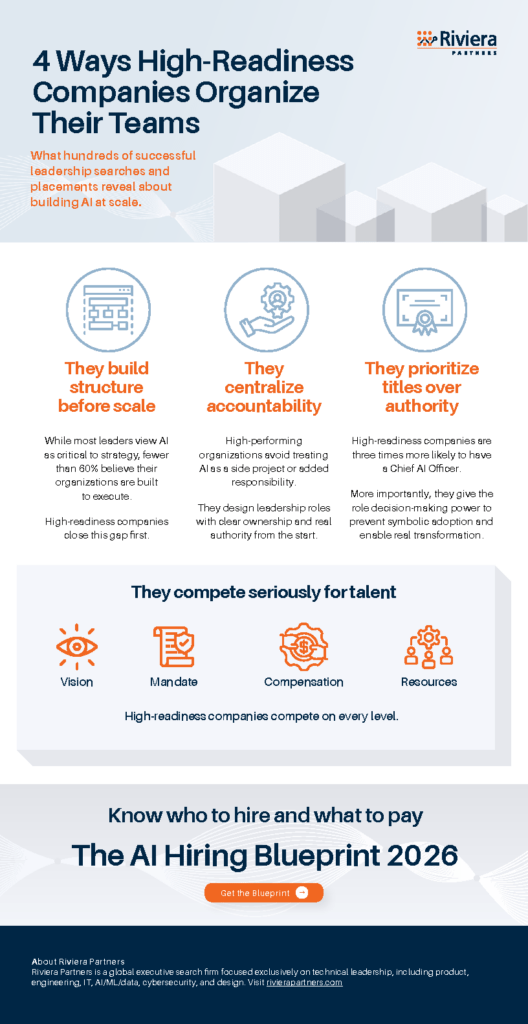
The infographic below summarizes how these organizations organize their teams in 2026.
Why Organizational Design Shapes AI Outcomes
In most companies, AI initiatives cut across product, engineering, finance, legal, and operations. Without clear ownership, priorities become difficult to coordinate.
While most leaders describe AI as central to business strategy, fewer than 60 percent believe their organizations are built to execute on that strategy. This gap reflects unresolved questions about who owns decisions, how resources are allocated, and how success is measured.
High-readiness organizations address these issues before scaling programs.
Four Structural Patterns in High-Readiness Organizations
Across venture-backed, private equity-backed, and public companies, several organizational patterns appear consistently.
Building Structure Before Scaling Programs
High-performing companies resist the temptation to scale quickly.
Before expanding pilots or launching broad initiatives, they focus on:
- Clarifying reporting relationships
- Establishing governance processes
- Defining funding models
- Setting performance metrics
This work is often less visible than product launches, but it shapes long-term outcomes.
Organizations that skip this stage frequently encounter coordination problems later.
Centralizing Accountability
In many early AI programs, responsibility is spread across multiple teams. No single leader owns results.
High-readiness companies take a different approach.
They design leadership roles with:
- Clear authority
- Defined scope
- Control over key resources
- Responsibility for adoption
AI is treated as an enterprise priority rather than an experimental function.
Prioritizing Authority Over Titles
Job titles alone do not determine impact.
High-readiness organizations are more likely to appoint Chief AI Officers or equivalent roles. More importantly, they give these leaders real decision-making power.
In practice, this often means:
- Direct access to the CEO
- Influence over budgets
- Authority over standards
- Responsibility for cross-functional alignment
Without these elements, AI leadership roles tend to become symbolic.
Competing Seriously for Talent
Organizational design and compensation are closely linked.
High-readiness companies recognize that experienced AI leaders evaluate opportunities based on several factors.
Candidates consistently assess:
- Strategic mandate
- Organizational support
- Compensation structure
- Access to data and teams
- Leadership alignment
Vision and mission statements matter. So do resources and authority.
Companies that compete on all dimensions are more likely to attract and retain strong leaders.
👉Related: Where AI Leaders Are Doing Their Best Work
Why Many Organizations Remain in “Pilot Mode”
Across hundreds of searches, several challenges appear repeatedly.
AI initiatives stall when:
- Authority is unclear
- Governance is fragmented
- Budgets are unstable
- Incentives are misaligned
In these environments, leaders spend more time navigating internal complexity than delivering outcomes.
Over time, this limits organizational learning and slows progress.
Using Organizational Design as a Hiring Tool
High-performing companies treat organizational design as part of the hiring process.
Before launching a search, they clarify:
- What the role owns
- How it fits into executive leadership
- How performance will be evaluated
- What resources are available
This alignment makes searches more efficient and improves long-term retention.
A Reference Point for AI Readiness in 2026
The infographic reflects a broader set of findings from Riviera Partners’ AI research and search activity.
The full AI Hiring Blueprint 2026 provides:
- Organizational readiness models
- Executive role frameworks
- Compensation benchmarks
- Market trends
- Search best practices
For boards, executives, and HR leaders evaluating AI leadership strategies, it offers a practical reference.
👉 Explore The 2026 AI Hiring Blueprint to access the full report.
About Riviera Partners
Riviera Partners is a global executive search firm focused exclusively on technical leadership, including product, engineering, IT, AI/ML/Data, cybersecurity, and design.